


New Heights
Mendoza spreads out before me, below verdant poplar and acacia trees waving at the city’s edges. The high desert rolls out in every direction: the Mendoza River bed—dry on this South American summer day—cuts a path eastward. The desert landscape pushes out in warm muted colors straight to the horizon, where it smacks into the staggering Andes mountain range. Out there, I know, is wine.
Wine is what I’ve come to Mendoza for. Not for the rustic reds that first made Argentinian wine famous, but rather for a new breed of wine. Wine that’s elegant and lifted. Floral. Full of rocky minerality. The new Argentine wine. High-altitude wine. Mountain wine.
This arid and fertile winemaking region, known as the Cuyo region, is in the central west of Argentina at the foot of the Andes. Cuyo, or “desert country” in the Huarpe Millcayac language of the Native peoples who once inhabited the area, is the most prolific winemaking region in South America, boasting 95 percent of the total area planted in Argentina. Cold in winter, hot in summer, and seriously influenced by those soaring Andes, it’s here where the diverse character of the country’s viticulture is most evident.
An American in Argentina
A mere 30 minutes south of Mendoza, in the Luján de Cuyo district, Viña Cobos (vinacobos.com) is a gleaming, modern winery.
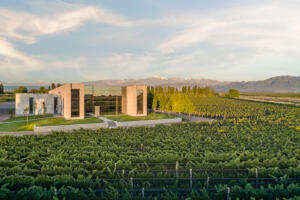
Multistory windows reflect vineyards decked in green with snowcapped mountains in the distance behind. This is the premier South American winery of renowned world winemaker Paul Hobbs, who also has vineyards in Valle de Uco farther south. Hobbs landed in Argentina in 1989 at a time when, he says, everything in this part of Argentina was rustic. “Nothing was sophisticated except for the people,” he explains, over a lunch of empanadas and bright, fresh salads. Argentina might have been the fifth largest winemaking country in the world at the time, but nothing was exported and, says Hobbs, most of the wines were oxidized. There was no modern winemaking equipment, and modern barrels had yet to arrive. “What an amazing dichotomy,” Hobbs says, reflecting on those early days.
It was because of those sophisticated people that Hobbs found his place in South American winemaking. Soon he, along with groundbreakers like Nicolás Catena Zapata, was convincing grape growers to move vineyards away from the salty soils nearer the coast and into the high deserts around Mendoza. Those vineyards would push up to the Andes to the west too.
Today, Hobbs’s Viña Cobos flourishes. A stroll through the estate shows where it all begins—meticulous rows of vines planted in stony soils. The winery itself is sleek and modern, and the hospitality center feels more like an art gallery than a tasting room. After lunch, a portfolio tasting with the winemaker reveals wines that are often more floral than one expects out of Argentina, full of bouncy acidity and fresh fruit. Later, on the winery’s rooftop, we lingered over pours of the vineyard-designated Zingaretti Estate chardonnay—with its notes of ripe pear and white tea and zippy acidity—taking in the last warm rays of sunshine as a pair of tango dancers seduced us with their moves.
A Legacy of Innovation
Just half an hour from Mendoza stands one of the region’s founding wineries, Santa Julia (santajulia.com.ar). Tito Zuccardi—an engineer who worked in concrete and irrigation—founded the family wine business by planting grapes here in 1963.
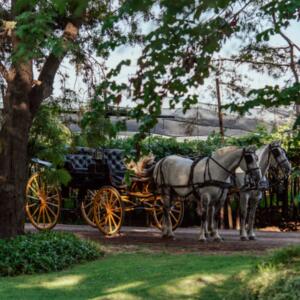
Five years later, Santa Julia, named after his granddaughter, was born. Today, the winery showcases the Zuccardi family’s organic and sustainability-driven efforts, its commitment to the community and its passion for hospitality. A tour of the vineyards led us into the Pan y Oliva, a small restaurant where we lingered over a lunch composed of fresh garden ingredients paired with Santa Julia’s bright wines. Then it’s off for a tour and tasting of Zuelo (zuelo.com.ar), the family’s olive oil division, which proves wine isn’t the only star in Mendoza. The evening closed with us hovering near vast outdoor grilling stations, eyeing the chefs as they prepared an asado. Empanadas lined a flattop; thick steaks sizzled above ruby coals. As night fell, we ducked into Casa del Visitante, where patriarch José Zuccardi insisted on serving up the best slices of meat for each of us, the family’s hospitality as rich and layered as their vintages.
A Visit to the Pyramid Among the Vines
Roll southwest out of Mendoza and you’ll hit one of the most iconic sites among South American wineries, belonging to one of Argentina’s most legendary names—Catena. Founded by an Italian immigrant family in 1902, Argentina’s Bodega Catena Zapata (catenazapata.com) is known first for its pioneering role in resurrecting malbec, and more recently for discovering extreme high-altitude terroirs in the Andean foothills. The pyramid-shaped Catena Zapata—modeled after pyramids founder Nicolás Catena Zapata saw in Tikal, Guatemala—rises unexpectedly from the vineyards to honor Argentina’s New World terroir.
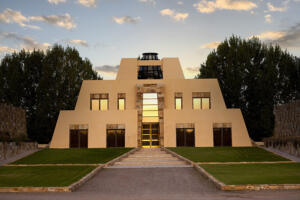
Inside, vaulted halls lead to intimate tasting rooms where the Catena family’s pioneering role in high-altitude viticulture comes alive. A guided tasting reveals the estate’s defining style—malbecs with soaring aromatics, chardonnays of Burgundian finesse—each bottle a reflection of Zapata’s vision to put Argentina on the world wine map. Now, his daughter Laura Catena is continuing this enduring mission.
Farther on is the Catena Institute of Wine, which, in collaboration with University of California–Davis and Universidad Nacional de Cuyo, provides viticulture and viniculture research and development programs.
Standing at the pyramid, gazing out across the vineyards to the Andes, you begin to get a sense of the high-altitude winemaking ambition at play here. Out there, in the Valle de Uco, with its rocky, alluvial soils set at the edge of those soaring mountains, these winemakers are driving a new style of Argentine wine. This mountain wine.
The Soul of the Valle de Uco
It’s here that vineyards cling to rocky soils set across alluvial floodplains at altitudes as high as 6,562 feet above sea level, where the vines are fed by glacial runoff and kissed by cool mountain breezes.
Down the hill and to the south is Paul Hobbs’s Viña Cobos Zingaretti Estate set on rocky soils at almost 5,000 feet elevation. There, an agronomic engineer led us on a vineyard walk, describing how the interplay of stony soils, sharp sunlight and chilly nights creates tension and freshness in these wines.
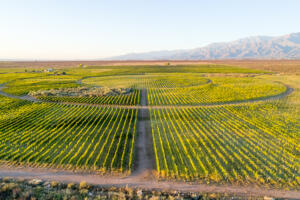
Farther to the south is Viña Cobos Chañares Estate, where the vineyards are set in a circle surrounded by chanar trees and a stone tasting room. Originally developed by three professors from University of Mendoza in 2008 with the idea of connecting the vines below to the cosmos above, the property was abandoned for a few years before Hobbs took it over with the intention of creating a vineyard-designated malbec program.
And that’s what we sipped on as we stood on a rooftop deck, gazing out at the acres of vines in front of us and the blue Andes beyond. Then we descended for an intimate empanada-making lesson and chance to picnic among the vines, dining on our own handmade creations while enjoying these Hobbs boutique wines.
The Valle de Uco is home to more than 70,000 acres of vineyards. Included among them are Zuccardi’s Gualtallary vineyards (zuccardiwines.com), a dramatic landscape of high-altitude vines set against a rugged mountain backdrop. It’s here that agronomist Martin di Stefano explained how altitude sharpens the wines’ acidity, while stony soils impart a signature minerality. Lunch at Estancia Cabo San Pablo (estanciacabosanpablo.com), a rustic ranch surrounded by wilderness, felt worlds away from city life.
The journey crescendoed at Zuccardi Valle de Uco, the family’s tribute to the Andes. Outside, a reflecting pool nestles against the winery’s angular, stone-studded walls. The striking, stone-clad architecture appears to rise organically from the rocky soils of the Paraje Altamira winemaking appellation—the very terroir that defines its wines. Inside, concrete winemaking vessels, known as amphorae, as well as a few oak foudres, highlight the winery’s minimalist, terroir-driven philosophy. We tour the winery and then dip in for lunch at the winery’s Piedra Infinita Cocina. Smoke from the nearby asado wafts in on occasion, but mostly this lunch showcases dishes designed to echo the landscape—earthy, pure, elemental—each paired with Zuccardi’s acclaimed single-vineyard wines. It’s the perfect finale: a celebration of place, people, and the extraordinary alchemy between the two.
Gualtallary Grandeur
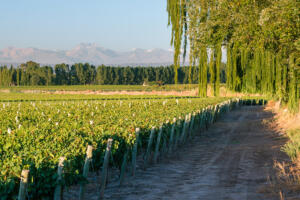
The Valle de Uco is home to more than 70,000 acres of vineyards. Included among them are Zuccardi’s Gualtallary vineyards (zuccardiwines.com), a dramatic landscape of high-altitude vines set against a rugged mountain backdrop. It’s here that agronomist Martin di Stefano explained how altitude sharpens the wines’ acidity, while stony soils impart a signature minerality. Lunch at Estancia Cabo San Pablo (estanciacabosanpablo.com), a rustic ranch surrounded by wilderness, felt worlds away from city life.
The journey crescendoed at Zuccardi Valle de Uco, the family’s tribute to the Andes. Outside, a reflecting pool nestles against the winery’s angular, stone-studded walls. The striking, stone-clad architecture appears to rise organically from the rocky soils of the Paraje Altamira winemaking appellation—the very terroir that defines its wines. Inside, concrete winemaking vessels, known as amphorae, as well as a few oak foudres, highlight the winery’s minimalist, terroir-driven philosophy. We tour the winery and then dip in for lunch at the winery’s Piedra Infinita Cocina. Smoke from the nearby asado wafts in on occasion, but mostly this lunch showcases dishes designed to echo the landscape—earthy, pure, elemental—each paired with Zuccardi’s acclaimed single-vineyard wines. It’s the perfect finale: a celebration of place, people and the extraordinary alchemy between the two.
Where to Stay in Mendoza
Diplomatic Hotel
The five-star Diplomatic Hotel is surrounded by restaurants, stroll-worthy outdoor shopping malls, and wine bars and offers sweeping views of Mendoza and the Andes range.
diplomatichotel.com.ar
Entre Cielos Wine Hotel & Spa
Each of the 24 minimalist, futuristic rooms at Entre Cielos features a private furnished terrace with views of surrounding Malbec vineyards. The hotel also features Argentinian cuisine in its Nube Restaurant, a spa with wine-based treatments and an authentic hammam.
entrecielos.com
Auberge du Vin
With 28 rooms opening directly onto vineyards, Auberge du Vin is an elegant, intimate refuge styled like a private residence. It offers impeccable views, a petite restaurant with fantastic dining, a bar and pool as well as opportunities for curated tastings and outdoor activities.
marriott.com
The Vines Resort & Spa
A sophisticated retreat of villas set amid grape trellises with the Andes as a backdrop. Each villa features floor-to-ceiling windows, private kitchenettes and generous terraces. On-site highlights include the famed Siete Fuegos restaurant by Francois Mallmann, a 100-label wine bar, pool, spa and equestrian activities.
vinesresortandspa.com
Casa de Uco Vineyards & Wine Resort
A sleek, contemporary 19-room sanctuary surrounded by vineyards and reflected in tranquil pools, this resort offers vinotherapy treatments, spa services, vineyard horseback rides, bike tours and exclusive DIY winery experiences.
casadeuco.com