


A Place at the Table
In 1928, a young man named Fujimatsu Moriguchi drove through Tacoma selling homemade fish cakes and other Japanese staples from the back of a truck. His customers were Japanese bachelors laboring on the railroad or in the logging and fishing industries, men with no one to cook for them at home. It was a modest operation with a homespun idea: that food is how you take care of people, and taking care of people is how you build a lasting sense of community.
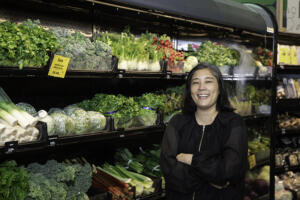
He was right. Nearly a century later, the company he founded is the Pacific Northwest’s most beloved Asian grocery chain, with four locations across the region and two more on the way. And it’s still family-run, by Fujimatsu’s granddaughter, Club member Denise Moriguchi.
Denise will tell you herself that she’s naturally introverted, more comfortable with data than with being the face of anything. She stepped into the role in her early 40s, when her aunt retired as CEO and the board ran a formal succession process. “I didn’t go away to college thinking my future career was running Uwajimaya,” she explains. “But when my aunt announced her retirement, everything lined up at once. I had my MBA, I’d worked in a few different companies, I’d just had my daughter in Toronto and wanted to come back to Seattle, back to family. And I felt strongly that I wanted Uwajimaya to continue to be family run, if possible. I wanted it to continue to succeed. All those things came together and I thought, ‘Okay, I think I want to do this.’”
What she didn’t expect was that the job would turn out to be less about groceries and more about people. “I thought I had to think about getting cans on shelves,” she said with a smile. But she quickly realized that it’s more about community. Her grandfather figured that out from a truck in Tacoma. Denise is learning the same lesson, at a much larger scale.
When those bachelor laborers in the 1930s started marrying, they suddenly had someone at home to make dinner for them and a truck was no longer enough. Fujimatsu and his wife, Sadako, opened a brick-and-mortar store in what was then Tacoma’s thriving Japantown.
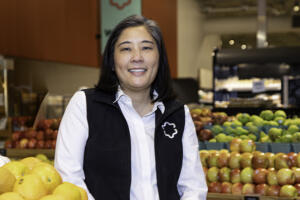 Then came World War II. The Moriguchi family, like tens of thousands of Japanese Americans on the West Coast, was interned at Tule Lake in California. When they returned to Seattle to start over, they did so the way many communities do: by taking care of each other.
During the late 1940s, Japanese American families pooled resources, each contributing a small amount to a pot, rotating monthly who received the full sum so that someone had enough to make a real move. Sign a lease. Buy inventory. Start again. That’s how Fujimatsu reopened Uwajimaya in Seattle’s International District in 1945.
In 1962, Fujimatsu hosted an exhibit at Seattle’s Century 21 World’s Fair selling chopsticks, Japanese bowls and rice crackers to nearly 10 million fair-goers. It was a visionary move: a small business owner from the International District planting his flag at the biggest cultural event the city had ever seen, betting that curiosity would do the rest. It turned out to be a major catalyst for the business, the moment that proved Japanese food and culture had an audience far beyond the Japanese American community.
By 1970 the store moved to a 20,000 square-foot location at Sixth Avenue South and South King Street, with distinctive blue roof tiles, a deli, live-fish tanks and a gift department stocking artwork, books, records, cosmetics, fabrics and kimonos. In 1991 Tokyo-based Kinokuniya bookstore opened its first Seattle location on the second floor, selling primarily Japanese language books, movies, music and periodicals.
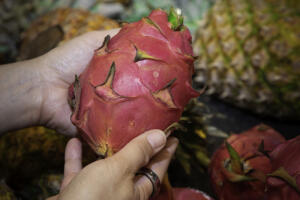 Denise grew up in that store. Her father worked there, and she would come along, running through the aisles with her cousins, helping bag groceries during the holidays. Staff members who watched her grow up now know her own children. “It wasn’t like a store that I went to,” she said. “It was like a second home.”
Her grandmother Sadako was the heart of it and worked in the store until she was 85. What she did there, mostly, was what grandmothers do across every culture: She fed people. Employees, customers, whoever was nearby. “She’d always be like, ‘Do you need something to eat?’” Denise said. “Every customer, every employee—she was just so kind and gentle.”
The Bellevue location opened in 1978; Beaverton, Oregon, in 1997; and Renton in 2009. In 1998 the company broke ground on Uwajimaya Village, a mixed retail and residential center covering three city blocks south of the King Street location. The new flagship opened in November 2000 at 60,000 square feet—nearly twice the size of the previous store—with a food court, bank, restaurant, optician, beauty salon and 176 apartments.
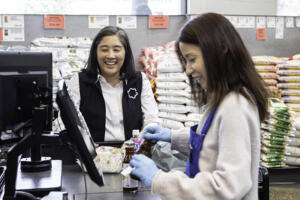 Now there are four stores and two more coming in 2027, including one in Issaquah and a return to Tacoma.
Over the last 20-plus years, the demographic and retail landscape in the region has changed considerably. There’s more competition now: H Mart, T&T, even non-Asian grocery stores stock a wider range of pan-Asian options. Denise takes this as a good sign. “That means there’s growth,” she said. That also means there’s an audience. And that there is: Between 1970 and 1980 the Asian population of Bellevue was less than 4 percent of the population. In 2026 it’s 43 percent.
These days, shopping is all about convenience. Since the pandemic, online grocery sales are around five times higher than prior to it. And while it carries all the essentials, Uwajimaya is more than just a grocery store—it’s a cultural touchstone that leaves you better for having shopped there—it sparks something by connecting you to the world.
I grew up making regular trips to the International District with my family, and Uwajimaya was always a part of it—the live fish tanks, the shelves full of labels I couldn’t read, the Hello Kitty section and the origami paper. My family isn’t Japanese American. It didn’t matter. We had a place there. My son is in college now, and his first request when he’s back in Seattle is still Uwajimaya; he’ll try new things from the deli section, bring home ingredients to cook with, explore the world with his senses. I told Denise this when we sat down together, and she lit up the way people do when they hear something that confirms what they already know to be true.
“I love that,” she said. “We nourish people, but it’s more than just food; it’s about the memories and the connections.”
When asked what the next 20 years hold for Uwajimaya, Denise replied, “To continue to be successful and grow and to provide those memories—that glimpse into other cultures.” She thought for a moment. “And keeping the business in the family.” uwajimaya.com