


The Face of Healing
Years ago, when Dr. Wayne Larrabee served as president of the American Academy of Facial Plastic and Reconstructive Surgery (AAFPRS), he invited the late Seattle artist Gary Faigin to one of the organization’s national meetings. Faigin stood onstage sketching two well-known surgeons while explaining how he studied a face—its proportions, asymmetries, planes and expressions. The lesson was practical. Dr. Larrabee believes surgeons who operate on faces should know how to draw them, even if their sketches never leave a patient chart. Anatomy can be memorized and surgical technique practiced, but neither ensures that a physician truly understands the face before them. “The craft you can teach,” he says. “The art is seeing the underlying person.”
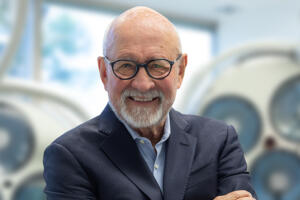 That distinction has guided him through more than four decades as a facial plastic and reconstructive surgeon, teacher and humanitarian. It also explains why photography and poetry intersect with medicine in his life, rather than running parallel to it. “The art isn’t separate from the surgery. It’s the same visualization,” he explains.
Dr. Larrabee first grasped the potential of reconstructive surgery far from any art studio or academic medical center. After earning a medical degree and a master’s in epidemiology from Tulane University, he served in the US Army as head of civic action and disaster relief for the Southern Command. This position took him throughout Central and South America, where he developed public health programs and responded to epidemics and natural disasters. In Panama, he spent time with the indigenous Guna communities from the San Blas Islands and assisted a missionary surgeon treating children born with cleft lips, cleft palates and other congenital conditions.
The experience redirected his career. Public health could improve life for an entire population, he knew, but reconstructive surgery offered an immediate and powerful result. “You spend a couple of hours in surgery and totally change a child’s life,” he says. He returned to surgical training and eventually focused exclusively on the face, drawn to its anatomical complexity and individuality.
For Dr. Larrabee, good surgery begins by recognizing the features that already belong to someone rather than imposing a standardized idea of beauty. Whether repairing a cleft lip, reconstructing an injury or performing a facelift, the goal is to preserve identity while restoring function, balance and appearance.
His background in public health also made him aware of the global burden of surgical disease—treatable conditions that become disabling because trained surgeons, facilities and equipment are lacking in some parts of the world. Cleft lip and palate, war injuries and facial trauma may require an operation rather than medication, yet surgery was long treated as peripheral to international public health. Through Global Surgical Outreach, the nonprofit he founded, Dr. Larrabee and other medical volunteers provide pro bono facial reconstructive care around the globe. Its work also includes education, infrastructure and long-term partnerships with local physicians.
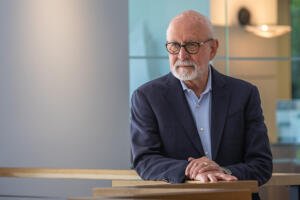 He is realistic about the limits of mission-based surgery, however. A visiting team can help the patients it sees that week, but training a local surgeon provides care for years. Often, physicians need focused instruction, equipment or access to techniques not available in their training programs. “We can’t treat every child in the world,” he says. “But we can train the local physicians to treat them.”
That approach has taken him to countries, including China, Croatia and now Vietnam, often returning to the same hospitals and colleagues over many years. In Croatia, he led teams treating facial injuries during and after the Balkan wars. In China, he worked with the late Canadian surgeon Dr. Joseph Wong to launch Smile China, which treated children with cleft lip and palate while building relationships with Chinese physicians. The friendships were important for successful missions.
As president of the AAFPRS, Dr. Larrabee helped establish the International Federation of Facial Plastic Surgery Societies. He and Dr. Wong also helped create what is now the Pan Asia Academy of Facial Plastic and Reconstructive Surgery. The idea behind those organizations is a global healing network: Surgeons separated by language, culture and politics can still operate together, compare methods, train younger physicians and bring that knowledge home.
In 1999, Dr. Larrabee became the founding editor of Archives of Facial Plastic Surgery, a peer-reviewed journal created under the JAMA umbrella, giving another way for physicians to learn from one another across borders.
Closer to home, Dr. Larrabee helped build a different kind of network after he started treating survivors of domestic violence. The work began informally when women were referred to him with broken noses, facial scars and other injuries caused by abuse. He repaired them at no charge, then partnered with shelters so referrals could come through advocates who understood each survivor’s circumstances. “You can’t look at yourself in the mirror every day, see the scars of domestic violence and not have them with you, mentally, all the time,” he says. The effort developed into the American Academy’s national FACE TO FACE Domestic Violence program, connecting survivors with surgeons who volunteered their services.
In 1996, Dr. Larrabee accepted the American Medical Association’s Major Public Service Award on its behalf, but he is quick to clarify why the honor matters. “It isn’t so much AMA recognition as the reality that we helped so many patients that is important to me,” he says, a sentiment he touches on with each turn of our conversation.
One woman, he recalls, whose nose he reconstructed after repeated assaults called him at home months later while another attack was underway. He contacted police who went to her home and stopped the violence. He later treated her again. She eventually left the relationship and rebuilt her life. He wrote a poem about the experience, part of a body of work that has appeared in many publications, including The Lancet.
 That story is the perfect example of how he integrates the scientific, humanitarian and artistic sides of his life. Surgery restored the woman’s face. Poetry helped him reflect on what the injury and recovery meant. Both required him to look beyond the physical problem to the person living with it.
His collaboration with Faigin grew from the same conviction. Faigin, who cofounded the Gage Academy of Art, spent his career analyzing how muscle movements and proportion communicate emotion. Dr. Larrabee studied his books, took his classes and published articles with him, including “Artists Examine Aging: How Attitudes Have Changed” and “The Art of the Smile.”
Dr. Larrabee shares life with his wife, Amy Smallman Larrabee, who helped manage the business for years and worked to organize the cleft missions, including recent ones to Ethiopia. In addition to the couple’s four biological children, they’ve adopted six kids from Costa Rica, Colombia, Mexico and Kazakhstan. Their younger children grew up swimming, celebrating birthdays and generally enjoying their time at Bellevue Club.
As he looks toward retirement in the next year or so, Dr. Larrabee expects to step away from operating, but not from the work itself. He plans to remain involved with Global Surgical Outreach, to mentor physicians and travel on future missions as an organizer, teacher and photographer. He also wants more time for poetry and photography.
The operating room may have been the center of his career, but his larger contribution is the network around it: surgeons teaching surgeons, physicians crossing borders to care for patients and artists helping doctors to see more clearly. All this good work ensures that Dr. Larrabee’s impact and knowledge will resonate loudly for many generations to come.