


A Better Way Around
“Around the World in Eighty Days” was so 1872. What if I told you it’s possible in less than a month, and that the journey itself is every bit as memorable as the destinations?
 As an expedition leader for TCS World Travel, my job is to shepherd guests from one awe-inspiring place to the next on private jet journeys across the globe. The company has been operating these expeditions for more than three decades, connecting some of the world’s most extraordinary destinations. Its Around the World itinerary links places as varied as Machu Picchu, Rapa Nui (Easter Island), the Great Barrier Reef, Angkor Wat and the plains of East Africa.
What’s it like? In a word, surreal. One day you’re watching the light shift on the white marble dome of the Taj Mahal and the next, a herd of elephants is crossing the dirt path in front of your safari vehicle in Kenya. You check off a life list of wonders in under a month: ascending Machu Picchu’s ancient citadel, visiting the moai in Rapa Nui, snorkeling on the Great Barrier Reef, seeing the sun rise over Angkor Wat (the world’s largest religious monument), standing at the feet of the Great Sphinx of Giza, wandering through Marrakech’s vibrant souks—and those are just the highlights. Moments in between are filled with quiet connection, unexpected discovery and encounters few travelers can experience.
The Experience
When I’m asked what makes these expeditions different, especially by those who are hesitant about group journeys, the answer often comes down to access. Some visits take place after public hours. Others are shaped by guides, scholars or hosts who bring a more personal understanding of the destination.
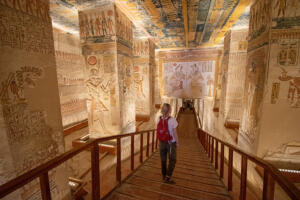
One of my favorite examples from a past expedition is the Valley of the Kings, an ancient Egyptian royal burial ground in Luxor. This remarkable archaeological site can draw thousands of visitors a day, and moving through the tombs’ narrow passageways during opening hours can feel claustrophobic. We returned after the crowds had departed, when several tombs were opened for the group. Without the daytime noise and congestion, guests could linger over intricate wall paintings and ornate chambers in a setting that felt almost suspended in time. It’s the kind of moment when history feels vividly present and difficult to put into words.
 And this type of access extends far beyond one destination. Guests might enjoy an elaborate dinner with traditional dancers at a temple in the Angkor complex or a tour of Rapa Nui led by an archaeological scholar. On other itineraries, they may arrive by vintage car at an 18th-century palace, have lunch on Bolivia’s salt flats beside an installation created for the group, step inside the kitchens of renowned chefs or receive a blessing at a Buddhist monastery.
Those are often the memories guests carry with them long after the trip ends. The landmarks may inspire the journey, but it’s these unexpected moments—the conversations, private meals, invitations and time spent with local guides—that leave the deepest impression.
The Care
Even the best-laid plans can’t account for everything the world may throw your way. Weather changes, unexpected closures and other surprises are simply part of travel, but the ability to adapt quickly can make all the difference. On one expedition, we departed Iceland early to avoid an approaching snowstorm. On another day, a last-minute museum closure required us to reshuffle the schedule. These adjustments are rarely visible to guests, and that is often the point. They simply learn that the day will unfold a little differently than planned.
A large team keeps the journey moving. The expedition leader oversees logistics and daily coordination, supported by assistants who manage everything from luggage transfers to administrative details. A dedicated physician travels with the group, while a professional photographer captures the moments along the way so guests can stay present. Onboard experts—including historians, scientists and journalists, along with local guides—provide deeper context for each destination.
For guests, much of the routine work of travel disappears. There is no need to coordinate transportation, make dining reservations or spend time researching which activities best suit their interests. Luggage appears in each hotel room and is collected before departure. Meals are arranged, and the expedition team offers recommendations based on what each guest enjoys most—whether someone wants to dive deeper into history, seek out a hidden corner of a place or simply slow down and take in the moment.
After years of leading journeys around the globe, I’ve seen how the most meaningful takeaways often come from moments of curiosity and connection—a conversation with a local guide, a glimpse into daily life or a deeper understanding of a history that once felt distant. Travel can make the world feel a little smaller and, in doing so, helps us approach it with greater empathy and appreciation.
The greatest luxury is not simply seeing more of the world. It’s having the time and freedom to be fully present in it.
The Jet
When boarding the custom-configured Airbus A321neo-LR, guests are greeted with “Welcome home” rather than “Welcome aboard.” After several weeks of returning to the same aircraft, the phrase begins to feel surprisingly accurate: The crew becomes familiar, guests settle into their preferred routines and the cabin provides a consistent point of return between stops.
 Unlike a commercial layout that would hold hundreds of passengers, the aircraft features just 52 lie-flat seats arranged two by two, each with an ottoman that makes it easy to pull up a seat and continue a conversation. It’s not unusual for friendships to form somewhere over the Pacific and continue long after the journey ends. An onboard chef prepares in-flight meals tailored to individual preferences, and on-trip experts present live lectures offering insights into the destinations ahead.
Piecing together far-flung locations on commercial flights would require lengthy layovers, complicated connections and considerably more time in transit. The aircraft flies directly between stops, with expedited airport security and minimized waiting wherever possible. More of each day can be spent exploring rather than moving through terminals.
Meet Your Guide
Amanda Zurita is an expedition leader, writer and endlessly curious traveler who has called Seattle home for nearly 20 years. With a background in classical studies and a passion for history, culture and exploration,  Amanda has visited more than 75 countries and led private jet expeditions across the globe. She strongly believes that thoughtful travel can be a force for good—that the more we see of the world and all who inhabit it, the more inspired we are to care for both.