


Tile Travelers
You can often hear a game of mahjong before you see it.
The tiles click and clatter against the hard surface as players “wash,” or shuffle, them—a sound often likened to a flock of sparrows taking flight. The association is fitting: In Cantonese, the game is called maa zoek (麻雀), or “sparrow.”
The Atrium is full of this joyful din on Friday mornings when member Jan Rogers and friends settle into their weekly game of Chinese mahjong. Jan is a true enthusiast who has played and taught this version of the game for 30 years. She also has antique tile sets displayed in her mahjong room, many handmade in China from bone and bamboo and each exquisite in its own way. While Jan and the women in her group play a Chinese-style version, over roughly a century and a half, mahjong has branched into dozens of variations worldwide, including Japanese, Taiwanese, Hong Kong and American styles. That is the true magic of mahjong: It is one game, endlessly reimagined. The tiles remain familiar, but the game evolves.
While its precise beginnings are debated, historians generally trace the game’s origin to the Yangtze River Delta—around Shanghai and Ningbo—in the mid- to late 19th century, where it evolved from earlier Chinese card games whose suits were adapted onto tiles. From there it spread across China, acquiring regional rules and customs as it went.
The game crossed the Pacific in the early 1920s through American expatriates, travelers, entrepreneurs and game companies eager to introduce something new. Joseph P. Babcock, an American who worked for Standard Oil Company in China, helped propel the craze with a simplified English-language rulebook known as “the Little Red Book,” published in 1920. Parker Brothers purchased the rights to his rules, and Abercrombie & Fitch (which some readers will be surprised to learn opened in 1892) is widely considered the first U.S. retailer to sell imported sets to an American public captivated by the tiles and the game’s air of exotic, cosmopolitan glamour.
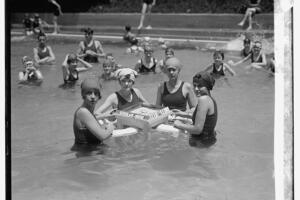 The first national frenzy faded almost as quickly as it had arrived, but mahjong did not disappear. It remained a meaningful cultural and social practice in Chinese American communities. In 1937, a group of players founded the National Mah Jongg League (NMJL) in New York to standardize the rules of a distinctly American version. [Editor’s note: The spelling mah jongg, used by the National Mah Jongg League, is commonly associated with the American version; mahjong is used here as the broader term for the game and its many variations.] Jewish American women played a central role in shaping and sustaining American mahjong, using regular games to build community in the Catskills and the expanding postwar suburbs. The organization, which began with 32 members, now reports more than 350,000.
The two versions share a strong family resemblance. Both are generally played by four people using illustrated tiles that are drawn and discarded until someone completes a winning hand. Both use numbered suits commonly called circles, characters and bamboo, along with honor tiles such as winds and dragons. Both rely on a shifting balance of luck, memory, observation and strategy.
In many Chinese variations, each player starts with 13 tiles and wins by acquiring a 14th. A standard winning hand contains four sets and a pair. A set might be three identical tiles, four identical tiles or a numerical sequence such as four, five and six of bamboo. Poker and gin rummy players will recognize the basic combinations. At Jan’s table, play begins with a tile-passing sequence the group calls a razzle, one of the practices that makes its game distinct.
American mahjong is more formally structured. It adds jokers and calls its tile-passing ritual the Charleston. Contemporary American sets often feature brightly colored acrylic, melamine or resin tiles, along with racks and patterned mats that soften the sound of play. The look frequently leans grandmillennial: a mix of classic chinoiserie and grandmotherly chintz. Think ginger jars, pleated lampshades and monograms—colorful, playful and maximalist. Chinese sets can have a quieter, more understated elegance. Both versions are gorgeous in their own way.
The most consequential difference between the versions is the NMJL card, published each year with the exact hands eligible to win. Chinese-style play is comparatively open-ended, while the American game asks players to recognize and pursue predetermined hands to win. Neither is a simplified substitute for the other. They are related games that demand different mental maneuvering.
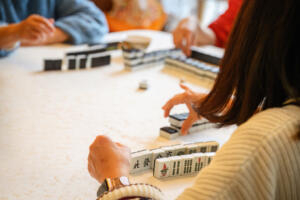 Today, the American version is enjoying a resurgence. At Mahjong Corner (mahjongcorner.com) in Bellevue, former Club member Donna Holmes teaches the game to a clientele that, she says, includes many women in their 40s and 50s. A game may take 15 to 20 minutes, allowing a group to complete five or six during a gathering. Donna leads classes and drop-in sessions and hosts events called Mimosas & Mahjong, Margaritas & Mahjong and Muu Muus & Mahjong.
The idea for this story arrived, fittingly, through another evolution of the game: Bam Dot Crack, an app Bellevue Club member and mahjong enthusiast Gaby D’Jaen co-founded with three longtime friends she met at the University of Michigan. Its name comes from the American terms for the game’s three suits: bams for bamboo, dots for circles and craks for characters.
Gaby’s background reflects the game’s multicultural journey. A Jewish American woman who grew up in Hong Kong, she owns a family tile set used for Chinese mahjong and remembers watching her grandmother play the American game in Michigan. Gaby learned American mahjong during the pandemic from friend and Club member Haley Sloan, who also taught Lauren Brazg, a fellow Bam Dot Crack co-founder. Today, D’Jaen meets every Monday night with Haley, Lauren and two other friends, rotating among their homes.
Mahjong with your friends, anytime, anywhere
The beauty of Bam Dot Crack is that it expands the mahjong table rather than attempting to replace it. Players can compete with friends, strangers or computer-controlled opponents and may upload their own current National Mah Jongg League card to reference during play. The goal is to inspire distant friends to play together and give newcomers a place to practice between in-person games.
 While the game’s social value is easy to see, its appeal extends beyond friendly competition and polite trash talk. Mahjong demands pattern recognition, memory, calculation and constant adjustment. A 2024 review of 53 studies found encouraging associations between mahjong and cognitive, psychological and functional health among older adults, though researchers cautioned that most of the evidence was observational. Regular social engagement is also associated with better overall well-being as people age.
Mahjong is a rare bird in the world of tabletop games. The rules may change from village to village, country to country or even table to table. But the throughline is remarkably steady: The game keeps bringing people back to the table—for the challenge, for the fun and, for many players, for a piece of family history.
Local Mahjong Resources
The Mahjong Corner
A local shop stocking authentic mahjong sets, tiles and accessories, with private and group lessons plus Wednesday evening social play.
mahjongcorner.com
Ponten Mahjong
Interested in Japanese-style riichi mahjong? Ponten Mahjong welcomes players of all skill levels and features four automatic mahjong tables, with instruction available for newcomers.
meetup.com/pontenmahjong
Seattle Mahjong Club
A welcoming community that teaches Taiwanese-style play through weekly meetups across Bellevue, Bothell and SeaTac—beginners encouraged.
meetup.com/seattle-mahjong-club-group