


Making a Splash
When Susan Pappalardo was spending long hours on pool decks as a swim parent, she assumed the long waitlists for lessons and scarcity of available pool space were temporary. Surely, in a region surrounded by water and known for prioritizing health and recreation, access to public pools would eventually catch up with demand.
It didn’t.
 “As a swim parent and Masters swimmer, you really see the system from the inside,” Susan says. “We’re driving everywhere, spending a lot of time on the road just trying to find pools.”
It’s a sentiment echoed by many local families who recall carpooling to the Weyerhaeuser King County Aquatic Center in Federal Way on school nights for meets and practices—sometimes hours from home.
Forward Thrust, Then and Now
What Susan gradually realized was that the problem wasn’t new, nor was it simple. Much of the region’s public aquatic infrastructure was built more than half a century ago during a period of unusually ambitious public investment known as Forward Thrust.
In 1968, King County voters approved a series of bond measures designed to address rapid population growth and invest in social infrastructure. Championed by lawyer and civic leader Jim Ellis, Forward Thrust funded parks and more than a dozen public aquatic centers across the region. Facilities such as the Bellevue Aquatic Center and Mercer Island’s Mary Wayte Pool were built in the early 1970s and followed a similar design model: six-lane pools, limited seating and programming focused on lessons, open swim and lap swim.
“And here we are, more than 55 years later,” Susan says. “We haven’t created new water. We’ve just reinvested in old facilities.”
Since the Forward Thrust era, the Eastside population has grown by more than 200,000 people. Aquatics programming has evolved, the region has become more diverse, and demand for lessons, competitive training, therapy and recreation has increased dramatically. At the same time, construction costs have risen sharply and public trust in large bond measures has declined. In recent years, several cities have attempted to fund new aquatic centers through levies or bonds, only to see those measures fail at the ballot box.
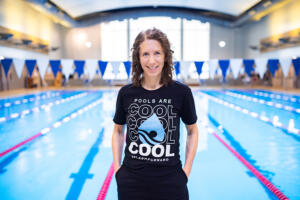 What began as a personal frustration became a broader civic question: How does a region that hasn’t made a major public investment in aquatics in more than five decades build the next generation of aquatic centers?
That question ultimately led Susan to cofound SPLASHForward, a nonprofit organization working in partnership with the City of Bellevue to bring a new, next-generation Bellevue Aquatic Center to life.
In many ways, her work represents a 21st-century counterpart to Forward Thrust—an effort to rebuild social infrastructure in a very different political and economic era, one where large-scale public projects increasingly depend on public-private partnerships.
If successful, it would mark the first major investment in new public aquatic infrastructure in King County in more than half a century.
The Meeting That Changed Everything
In the fall of 2017, Susan attended a meeting at Bellevue Club about a dormant city feasibility study exploring a new public aquatic facility.
“I raised my hand and put my name on a piece of paper,” she says. “I had no idea that today I’d be pretty much 24/7.”
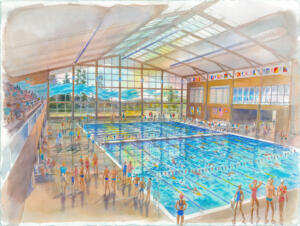 SPLASHForward officially formed in 2018 as a nonprofit advocacy organization dedicated to supporting the city’s efforts.
Susan’s background as a program manager at Microsoft proved unexpectedly well suited to the task. Spend a few minutes talking with her and it’s clear she knows how to wrangle complexity, align stakeholders and keep projects moving.
“I left Microsoft when I had my kids,” she says. “But I always knew there would be something else for me. This allowed me to reignite my professional skill set and do something I love.”
As if her schedule weren’t already full, Susan also launched a High School Lifeguard Training Program in partnership with Bellevue Club in 2021. The program has provided more than 422 local students with free lifeguard certification, job resources and mentorship. This year, SPLASHForward is piloting Every 2nd Grader Learns to Swim, a program that offers free lessons to more than 70 second graders at Stevenson and John Muir elementary schools, both Title I schools.
The Vision
Plans for the new Bellevue Aquatic Center envision a 130,000-square-foot facility housing five distinct bodies of water: a 50-meter competition pool with a movable bulkhead; a deepwater pool for diving and water polo; a warm-water therapy pool; a program and teaching pool; and a leisure pool with zero-entry access, a lazy river and slides.
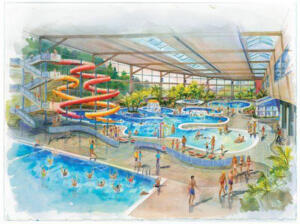 The facility would also include dry-side fitness areas, community rooms and flexible studios.
“We’ve modeled everything,” Susan says. “From morning to night, weekdays to weekends, school use, club use, regional events. We’ve looked at operations, staffing and cost recovery. Sustainability is critical.”
Masters Teammates
SPLASHForward has drawn strong support from Bellevue Club members who share a lifelong connection to aquatics. Many are longtime Masters swimmers and advocates for broader community access to water safety, fitness and play.
Board member Nancy Wenke-Price, who spends part of the year swimming at the Palm Desert Aquatics Center, notes that building a new aquatics facility is a massive undertaking that will help Bellevue catch up with the rest of the country. “To get this huge thing off the ground, it needed a Susan—and we got a Susan,” she says.
Masters swimmer and board member Erik Teutsch adds that swimming is “a fantastic way to stay healthy, recover from injury and relax,” noting that the safety benefits of swim lessons “can’t be overstated in this region, with the Salish Sea, local lakes and so many places where we recreate in the summer.”
Tim Adkisson, whose parents were founding members of Bellevue Club, was the initiative’s first major private donor, honoring his late wife, Joan, whose love of swimming and belief in water safety inspired a gift that helps make this vision possible.