


Wings Over Washington
The wild birds from the Arctic fly through Washington every fall and winter, arriving like sentinels of the season’s change. First to arrive in late September are the snow geese, flying in their loose “V” formations, sometimes in the thousands as they cross the sky.
They settle onto their desired landing spots in the open fields of western Washington’s Snohomish, Skagit and Whatcom Counties, where they congregate together in white expanses that look like snow to passing drivers.
 Next to arrive in late October are the swans—trumpeter and tundra—which can be seen gleaning in post-harvest potato fields all winter. The swans’ graceful appearance on land belies their true heft when trying to fly after gorging on those potatoes, their group takeoff something comical to witness.
Last to arrive (usually by December), and possibly the most anticipated by nature photographers, are the short-eared owls. These slender diurnal owls hunt the fields for voles, flitting like daytime moths back and forth, low over the landscape. Mount Baker is a stunning backdrop to their hunting ground.
Cold-weather birding has a quiet magic to it. The stillness of winter sharpens every sound and the landscape feels spacious and uncluttered. Three locations across the state offer an ideal entry point into this experience, with wide-open views of iconic species, visitor-friendly access and a deeper appreciation for the birds that depend on these winter landscapes for survival.
Skagit Valley
The rich agricultural region of the Skagit River delta lies only 70 miles north of the Bellevue-Seattle metropolitan area; it’s the ideal beginner birder starting point. The birds are abundant and easy to see in the open landscape, and there are numerous public parks, Washington Department of Fish and Wildlife preserves and walking trails where birding is supported through information online and signage on-site.
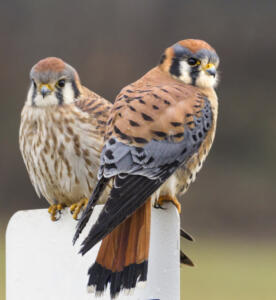
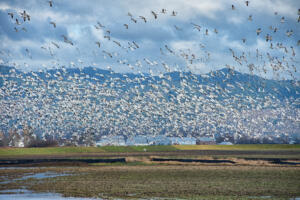 A bird-curious city dweller could easily bird-watch from a car or stop at any of the public access areas in the Skagit flats from Conway across the valley to Bow/Edison. Along the route, a beginner birder might see snow geese in the fields, red-tailed hawks and American kestrels (a small falcon) on utility wires, bald eagles silhouetted in trees and, maybe, a chance view of a short-eared owl.
The Skagit Audubon Society (skagitaudubon.org) has up-to-date information for the best birding areas in Skagit and a printable map.
Columbia Basin Region
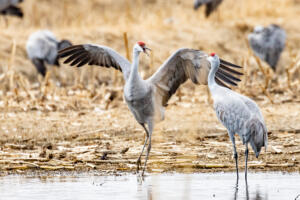
In March, head east of the Cascades to see North America’s largest bird, the sandhill crane. Each year the town of Othello, in Adams County, hosts the annual Sandhill Crane Festival (othellosandhillcranefestival.org), where birders have been gathering for 20 years to witness the arrival of nearly 35,000 cranes as they travel north to their breeding grounds in Alaska.
A birding festival is an instructive way for beginner birders to experience this new pastime, and the sandhill crane, standing at four feet tall, warrants the attention of its namesake event. For about a month in late winter the birds visit this area of eastern Washington in flocks of thousands.
The birds forage in fields during the day and roost in isolated scrub steppe near the water at night. Imagine standing beneath a pink-hued sky at dusk as thousands of birds fly overhead, covering the sky like an undulating screen of movement.
Grays Harbor
Another visual avian wonder comes in early spring, this time on the Washington coast near Aberdeen and Hoquiam.
Thousands of tiny shorebirds amass on the mudflats of Grays Harbor on their migration north to breeding grounds in Canada and Alaska.
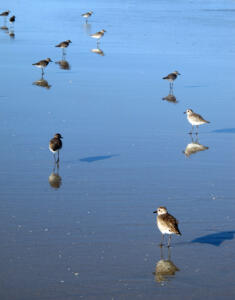 During the last week of April and the first week of May, along the boardwalk of the Grays Harbor National Wildlife Refuge, you can see shorebirds like plovers, sandpipers, dowitchers, red knots and dunlins moving en masse across the mudflats like twinkling sand. These birds also fly in huge flocks together, shifting direction and catching the light, in a flight sequence called a murmuration. To witness this flight display is mesmerizing: you are watching a literal moving cloud of live creatures dancing in the sky.
The Grays Harbor Shorebird and Nature Festival (shorebirdfestival.com) takes place during the peak of shorebird migration in early May and offers field trips and educational programming to enhance your visit.
Learn More
Find a meet-up or join a bird walk through your local Audubon Society (audubon.org) or parks department. Joining a walk led by a more experienced birder is the best way to start and improve your birding skills. I honed my own birding skills from years of such walks.
Ethical Birding
Skagit Valley, the Columbia Basin, and other birding areas outside county, state or national parks and refuges are privately owned, so visitors must abide by all private property and parking laws. Make the most of public parking areas when you pull over or enjoy the birds from your car.
Spend money locally and tell local businesses and people you meet that you are visiting as a birder. You may gain some inside scoop on a bird someone has seen, plus you’re supporting the birding economy.
 Give birds and wildlife space to be wild. Migration is a time of exertion for birds, and they spend their energy foraging to restore energy. Human disturbance can have a significant impact. Read and follow the American Birding Association’s Code of Birding Ethics (aba.org) to be a respectful birder from the start.
Borrow or invest in a pair of binoculars (an 8 x 32 binocular is a good starting point), and download a bird identification app like Merlin from the Cornell Lab of Ornithology for your phone. Binoculars allow for watching birds from a safe distance, and the Merlin app will provide a baseline for visual and auditory birding identification.